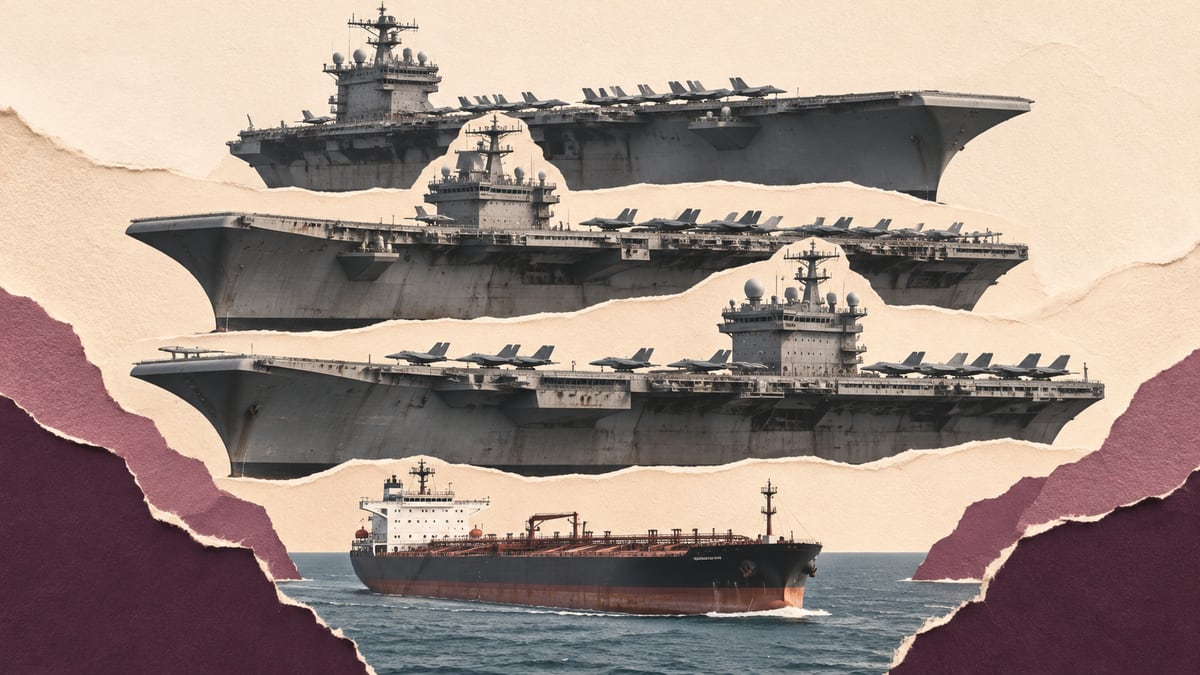
US Central Command said on Monday that the USS Theodore Roosevelt is operating in the Middle East as the region’s third US aircraft carrier, adding thousands of troops to forces blockading Iranian shipping. The carrier crossed the Indian Ocean on 15 November and is in Central Command’s area “as part of a scheduled deployment.” Israeli journalist Barak Ravid wrote on Sunday that a US official told him the Roosevelt had entered that area earlier the same day, giving the US military three carrier strike groups there.
The Roosevelt joins the USS George Washington and the USS George H.W. Bush. The US Navy said the Arabian Sea flotilla also includes 13 destroyers, two cruisers and a littoral combat ship. A Bloomberg report said the Roosevelt might replace another carrier, though all three could remain. An unnamed US defence official told Bloomberg that the deployment gives President Donald Trump more military options if he restarts active hostilities, and that the departure of the Washington or Bush group could suggest Washington is not planning another large-scale air campaign.
Iran’s Revolutionary Guard navy said mines have damaged six oil tankers since Sunday and polluted coastlines along the Strait of Hormuz. On Monday, Iranian state television relayed a warning from the Guard’s naval arm and the army that mines had made a US-supported route through the strait dangerous for shipping companies. United Kingdom Maritime Trade Operations said a tanker attempting the crossing was hit by a projectile and its engine room caught fire, with no casualties. It was unclear who fired that projectile, or whether Trump intends to order renewed large-scale strikes.
Before the war, a fifth of the world’s oil travelled through the strait. Lloyd’s List assessments show traffic remains below a third of its prewar level. Central Command said the blockade has diverted 150 merchant vessels and disabled five since June.
Trump began the war against Iran alongside Israel in February. The US and Iran entered a two-week ceasefire in April, when the Bush arrived and the Navy had three carrier strike groups in the region for the first time since 2003. A broader memorandum of understanding announced in June collapsed in early July. The Washington reached the region in August. The Roosevelt and its strike force left San Diego in September.
The USS Makin Island amphibious readiness group deployed with the Roosevelt and includes the landing ships USS John P. Murtha and USS Anchorage. The Guardian said about 2,000 Marines are aboard and the group has not yet reached the region. Al Jazeera reported that the group had more than 2,000 Marines and had followed the carrier into the region.
Vice President JD Vance told Fox News, as reported by The Independent, that Trump “is not going to let this become a forever war, and the people who want it to become a forever war, they can attack me all they want to because we signed up to not do this.” The Roosevelt’s arrival came nearly two weeks after Republicans suffered major midterm losses, which The Guardian attributed partly to the Iran war’s unpopularity and its economic effects. Vance later broke publicly with Trump, writing on X that “the reason we lost is the war” and, “If you'd like to argue it was worth it, that losing the Senate for the next 6 years was worth it, then do so.”
Al Jazeera reported that the administration has appeared increasingly divided over Iran since the midterms. A poll published last week and cited by The Independent found that 71% of Americans want the incoming Democratic-controlled Congress to pass legislation ending the conflict, including 93% of Democrats and 51% of Republicans.
In the week before the carrier’s arrival, Trump warned Iran that the US military was “locked and loaded” and said the US was watching Pickaxe Mountain, a facility tied to Iran’s nuclear programme. He told Hugh Hewitt on 12 November, “If something does not work out, I would not hesitate.” After meeting Qatar’s prime minister, he said major new strikes were unlikely and that the war “militarily is effectively over.” He said he told Vance, the lead US negotiator, “We don't need a deal with Iran.” On Truth Social he wrote that the need for a deal had long passed, adding, “We've got their money, Hundreds of Billions of Dollars, and we've got their Strait!”
Secretary of State Marco Rubio said earlier that economic pressure was working and that large-scale military operations were likely unnecessary. “The economic pressure on Iran is going to get even worse,” he said. Iran’s deputy foreign minister, Kazem Gharibabadi, told Iranian state television that US forces “have had no success with either an air blockade or a land blockade.” He said Iran would withhold access to its facilities from the International Atomic Energy Agency “until Iran's conditions are met and the war has permanently ended.” Those conditions include ending the US blockade of Iranian ports, lifting sanctions, releasing frozen funds and expressly declaring the conflict over. He had earlier said Iran “will not wait for the US to attack first.” Ali Vaez of the International Crisis Group said each side is caught in a perilous game of chicken, believing it may be safer to strike first than to wait.
Ronald O'Rourke, a former longtime Congressional Research Service analyst, said a sustained presence of three carriers could worsen Navy readiness problems. A prolonged deployment of two would strain the force, he said, and three would put it under much greater strain.